
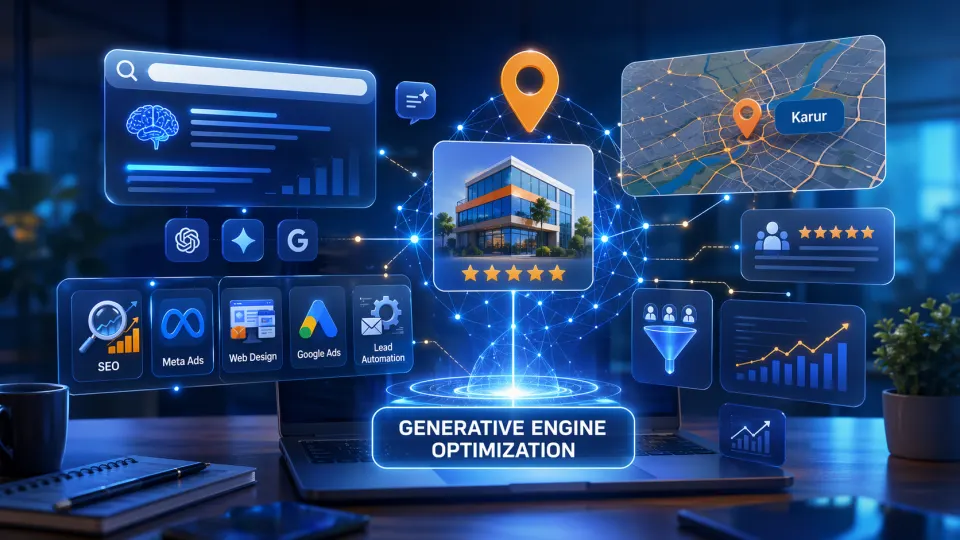
Search has moved into a new phase. People still search on Google, but they now ask AI systems for recommendations, comparisons, summaries, and direct answers before they ever click a website. That changes what it means to rank. In many cases, the real competition is no longer just a blue-link position. It is whether your brand becomes part of the answer.
This is where Generative Engine Optimization, or GEO, becomes useful. GEO helps your business show up more clearly inside AI-powered search experiences such as Google AI Overviews, Gemini, ChatGPT, and other answer engines. It builds on SEO, but it pushes further. Instead of optimizing only for crawlers and rankings, you are optimizing for interpretation, summarization, trust, and recommendation.
What Generative Engine Optimization Really Means
Generative Engine Optimization is the practice of improving how AI systems understand and present your business. Traditional SEO focuses on visibility in search results through content, technical health, internal linking, and authority. GEO uses that same foundation, then improves the signals AI tools rely on when generating answers.
AI systems do not only read one page. They compare information from your website, service pages, FAQs, reviews, business profiles, social accounts, citations, and other web sources. If all of those signals line up, your business becomes easier to trust. If they are inconsistent or too generic, your visibility becomes weaker even when you have decent SEO.
AI systems need a clean explanation of who you are, what you offer, and who you serve.
Schema, headings, FAQs, and organized pages make your content easier to extract and cite.
Reviews, proof, case studies, and consistent mentions strengthen recommendation potential.
1. Start With Strong Entity Clarity
The first step in ranking higher with GEO is making your business identity obvious. Many websites still describe themselves in vague, broad language. That creates friction. If an AI tool has to guess what your company does, where it works, and which problems it solves, you are already behind.
Your homepage and service pages should answer four questions quickly:
- Who are you?
- What exactly do you offer?
- Who is the service for?
- What result do you help create?
That is why clear service pages for SEO optimization, Meta Ads, Google Ads, and website designing matter so much. Each page should define the service, explain its role, and connect it to the right business outcome.
2. Build Pages That Answer Questions Directly
AI search rewards answer-first content. That means your pages should not take too long to get to the point. If someone asks, "How can I rank higher with GEO?" the best content responds directly, then expands with proof, examples, steps, and context.
For important pages, use clear heading structures and short lead paragraphs that immediately state the value of the topic. Then support that with sections that explain process, use cases, mistakes, and next steps. This kind of structure works well for both users and AI systems because it is easy to scan, easy to summarize, and easy to cite.
Some of the best formats for GEO-friendly content include:
- Service pages with direct introductions
- FAQ sections tied to real customer questions
- Comparison pages
- Local landing pages
- Case studies with outcomes
- Practical blog posts written around clear intent
3. Use Schema to Remove Guesswork
Schema markup helps AI systems understand page purpose, business details, services, FAQs, and content type without needing to infer everything from prose. This is one of the easiest ways to improve machine understanding while keeping the visible design exactly the same.
For businesses that want better AI visibility, the most useful schema types often include Organization, LocalBusiness, Service, WebSite, Article, and FAQPage. The important part is alignment. Your schema should reflect what the visible page already says. If the page discusses local SEO, paid ads, and lead generation, the structured data should reinforce that story, not contradict it.
Schema will not rank a weak page by itself, but it makes a strong page easier to interpret. That matters more as search becomes more conversational and answer-driven.
4. Strengthen Trust Signals Across the Web
GEO is not a website-only activity. AI systems compare what your site says with what the rest of the web says about you. If your business listings, review profiles, social accounts, and mentions all support the same brand identity, your authority becomes easier to confirm.
That means your business should keep its core information consistent:
- Business name
- Location or service area
- Phone number and contact details
- Core services
- Brand description
- Social profile links
It also helps to collect reviews that mention specific services and outcomes. Reviews that say "great service" are useful, but reviews that mention SEO improvement, website results, ad performance, or lead quality are much stronger for AI understanding.
5. Create Content Around High-Intent Search Behavior
One of the best ways to rank higher is to create content around the kinds of questions buyers ask right before they choose a provider. AI search often appears earlier in the decision process than a website visit, so content that answers commercial questions can become especially valuable.
Instead of only targeting broad, informational terms, create content around questions like:
- Which service is right for my business?
- How do I improve lead quality from paid ads?
- What makes a website convert better?
- Should I choose SEO, Google Ads, or both?
- How do I show up in AI search results?
These are stronger intent signals than broad awareness searches. They let your content meet users at the point where research starts turning into action. That is why practical content often performs better than vague trend content alone.
6. Support GEO With Real Experience and Proof
AI systems increasingly prefer content that looks trustworthy and grounded in real experience. If your site makes strong claims but shows no examples, no testimonials, no process, and no supporting evidence, it becomes harder to stand out.
Proof can take many forms:
- Case studies
- Client feedback
- Portfolio examples
- Before-and-after performance summaries
- Author expertise or organization expertise
- Clear process sections
This is also where good content marketing helps. Strong content should not just explain a concept. It should show experience behind the explanation. Pages connected to content marketing and lead automation become more valuable when they demonstrate practical business outcomes instead of staying theoretical.
7. Improve Internal Linking So Context Flows
Internal links do more than move users around the site. They also help search systems understand relationships between topics. If your blog post discusses GEO, it should naturally connect to your related services and supporting educational content. That creates a stronger topic cluster and gives AI systems more context around your expertise.
A good internal-linking structure should connect top-of-funnel education to mid-funnel service pages and bottom-funnel conversion pages. In practice, that means your GEO article should point readers toward related solutions like SEO services, conversion-focused web design, and performance-driven campaigns where those links genuinely help the reader.
8. Test How AI Systems Describe Your Brand
One of the most useful GEO habits is testing how different AI tools describe your business after you make improvements. Ask practical questions the way a customer would. See whether the answer reflects your positioning accurately. If the response is vague, incomplete, or wrong, your signals still need work.
Good prompts for testing include:
- What does this business do?
- Who is this service best for?
- Which businesses should choose this agency?
- What makes this company different?
- What services does this brand provide?
This process helps you identify gaps in clarity, proof, structure, and entity consistency. It also keeps GEO practical. You are not optimizing for theory. You are optimizing for how real answer systems currently interpret your business.
Common GEO Mistakes That Limit Rankings
Most GEO problems are not caused by a total lack of content. They usually come from weak positioning, generic writing, missing structure, and inconsistent external signals. Many brands publish long pages that say very little. Others depend too heavily on AI-generated copy with no original perspective. Some have solid content, but their service pages, citations, and reviews do not align.
The biggest mistakes usually look like this:
- Generic homepage copy that does not explain services clearly
- No visible FAQs or answer-first sections
- Weak or missing schema markup
- Little proof of results or expertise
- Inconsistent business details across platforms
- No content tied to buying-stage questions
Frequently Asked Questions
How do you use Generative Engine Optimization to rank higher?
You use GEO by clarifying your business identity, improving answer-first content, strengthening structured data, building proof, aligning citations and reviews, and connecting your site around real user intent.
Does GEO replace traditional SEO?
No. GEO works best when technical SEO, page speed, mobile usability, content quality, and internal linking are already strong. GEO adds the layer that helps AI systems interpret and recommend that content more effectively.
What content types work best for GEO?
Service pages, comparison pages, expert FAQs, local pages, case studies, and practical educational content all work well because they answer real questions in a structured way.
Why is schema important for AI search?
Schema gives machine-readable context about your business and page content, which helps reduce ambiguity and makes it easier for AI systems to classify and trust what they are reading.
Want to Rank Better in Search and AI Discovery?
Raja Digital Media helps businesses improve SEO, GEO, website clarity, structured content, ad performance, and lead generation systems built for real growth.
Request a Strategy Session