
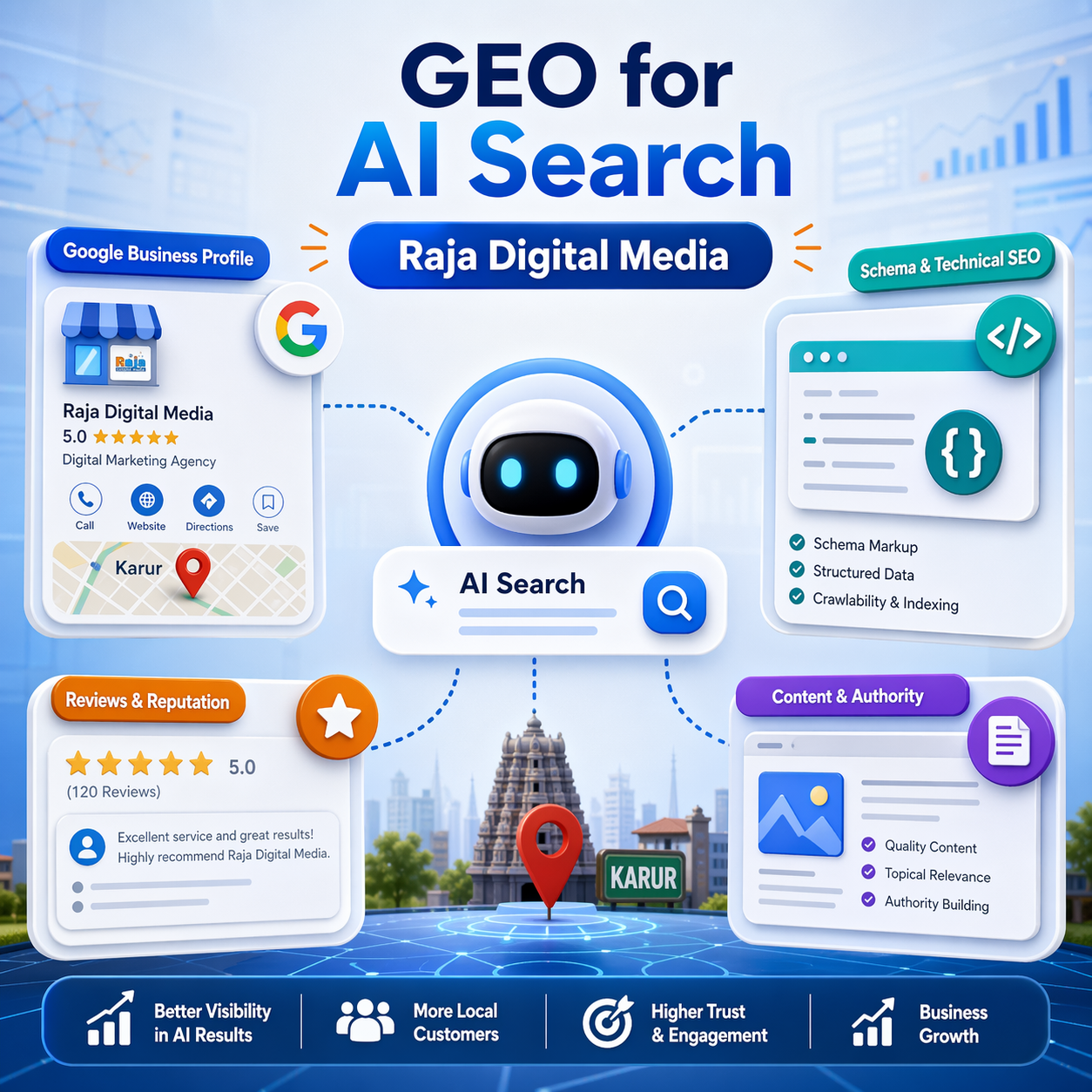
One of the most common questions businesses ask us now is simple: How do we show up in AI search results? It is a smart question, because search behavior is changing fast. People are using AI-powered search experiences to ask direct questions, compare options, shortlist agencies, and make decisions much earlier in the buying journey.
That means your business is no longer competing only for a place on page one. You are competing to become part of the answer. If your brand is not clear, trusted, and easy for AI systems to understand, you may miss visibility even when your service is exactly what the customer needs.
This is where GEO, or Generative Engine Optimization, comes in. GEO is not a replacement for SEO. It is the next layer. It helps your brand appear in AI summaries, recommendation lists, conversational search results, and answer engines where high-intent users are actively looking for a solution.
AI search often starts with buying questions, not just curiosity.
Brands that explain who they help and how they help get understood faster.
Authority signals decide whether your business gets cited or skipped.
Why AI Search Matters for High-Intent Leads
Traditional SEO often captures people at different stages of awareness. Some are researching. Some are browsing. Some are ready to buy. AI search is different because it tends to attract users who ask complete, decision-focused questions such as "best agency for local SEO," "who can improve lead quality," or "how to rank in AI search results for my business."
These are not weak signals. These are strong commercial signals. The person asking that kind of question is much closer to action. If your site has the right content, structure, proof, and brand authority, AI systems are more likely to surface your business as a useful answer.
What AI Search Engines Need to Understand About Your Brand
AI systems work by gathering signals from across the web and combining them into a probable answer. They look for patterns. They look for consistency. They look for authority. If your website, business profiles, service pages, reviews, and mentions all tell a clear story, your chances improve.
1. Clear entity signals
Your website should make it obvious who you are, what you do, where you operate, and who you serve. A vague homepage or generic service page makes it harder for AI systems to identify your business as a strong match. Use clear service names, specific industries, location references, author signals, and organization details. That is why pages like our SEO optimization service, content marketing service, and lead automation solutions matter beyond rankings alone.
2. Structured information
Schema markup, FAQs, headings, service definitions, and well-organized page sections help machines parse your content. AI systems do not reward confusion. The more clearly your content is structured, the easier it becomes to quote, summarize, or cite.
3. Proof of expertise
Case studies, testimonials, review signals, original insights, and real examples all strengthen trust. Thin content that says "we are the best" is weak. Content that shows process, outcomes, and experience is much stronger.

AI Search Rewards Brands That Make Sense Fast
If your content, metadata, and supporting signals all point in the same direction, your business becomes easier to trust. That is the real foundation of GEO. You are reducing ambiguity and increasing confidence.
The Core GEO Strategy: Answer Better Than Everyone Else
Many businesses still publish content written around a keyword and stop there. That is not enough anymore. For AI search, your pages need to satisfy real questions with direct, usable, context-rich answers. Good GEO content is easy to scan, easy to extract, and easy to trust.
That means each important page should answer questions like:
- What is this service?
- Who is it for?
- When should someone choose it?
- What results can they expect?
- Why should they trust your team over generic alternatives?
If you want to show up for high-intent AI searches, create content around bottom-funnel questions, comparison queries, solution-aware phrases, and local commercial terms. Instead of writing broad blog posts only, build assets like service explainers, pricing guidance, use-case pages, comparison articles, local landing pages, and expert FAQs.
How SEO and GEO Work Together
A strong SEO foundation still matters. Fast pages, mobile usability, crawlability, internal linking, canonical structure, and relevant backlinks continue to influence discoverability. GEO builds on that foundation by making your content more useful in answer-based environments.
Think of it this way: SEO helps your content get found. GEO helps your content get chosen. Businesses that do both well are in the best position to win organic traffic, AI citations, and direct leads from emerging search experiences. In practice, that means supporting service pages such as SEO Optimization, Google Ads, and Website Designing with stronger in-depth content and cleaner internal links.

Write for Questions, Not Just Keywords
The strongest AI-search pages combine search intent, clean structure, original perspective, and conversion logic. They do not just rank. They resolve the user's next question before it is even asked.
A Practical GEO Checklist for Businesses
If you want to move from theory to action, start here. These are the areas we focus on when helping brands improve their visibility in AI search results.
Tighten your brand message
Make your homepage and service pages clearly state what you do, for whom, in which locations, and with what outcome.
Build high-intent service content
Create pages for buyer questions, comparisons, industry use cases, local services, and solution-specific problems.
Use schema and structured sections
Add organization, service, FAQ, and article schema where relevant, and format content with clean headings and concise answer blocks.
Strengthen trust signals
Publish case studies, reviews, credentials, author context, process pages, and before-and-after business outcomes.
Improve your digital footprint beyond the website
Keep business listings, social profiles, citations, and mentions consistent so AI systems see a stable, trustworthy entity.
Common Mistakes That Keep Brands Out of AI Results
The biggest GEO mistake is assuming AI search is only about publishing more content. Volume alone will not help if your positioning is unclear. Another major mistake is depending on generic AI-written articles with no original insights, no proof, and no brand-specific value.
We also see businesses ignore local authority. If you serve a city or region, your location signals matter. Your content should reflect local expertise, local examples, and local trust indicators. For Raja Digital Media, that means not just talking about growth in general, but showing how businesses in Karur and beyond can use SEO, paid ads, websites, and automation together to create real business movement.
Final Thoughts: Visibility Is Now Earned in More Than One Search Layer
AI search is changing how discovery works, but the core principle is still the same: the most helpful and trustworthy source earns attention. GEO simply pushes businesses to be clearer about their expertise, more intentional about their content, and stronger in how they present proof.
If your business wants to show up in AI search results, start by improving the pages that matter most to revenue. Build clear service positioning. Answer high-intent questions better. Strengthen your authority signals. Then make sure your technical SEO and structured data support the story you are telling.
That is how you move from being indexed to being recommended.
Frequently Asked Questions
What is AI search optimization?
AI search optimization helps your business appear in AI-generated answers, summaries, and recommendations by improving clarity, authority, structure, and relevance.
What does GEO mean in digital marketing?
GEO means Generative Engine Optimization. It focuses on improving visibility inside conversational and AI-driven search experiences, not only traditional search rankings.
How do I rank in AI search results?
Start with strong SEO fundamentals, then improve entity signals, answer-first content, structured data, trust-building proof, and high-intent service pages that match what users are asking.
Is GEO different from traditional SEO?
Yes. SEO helps pages get discovered, while GEO helps content get understood, summarized, and cited inside AI search experiences. The strongest strategy combines both.
Want Your Business to Show Up in AI Search Results?
Raja Digital Media helps businesses build the SEO, content, structure, and authority needed to win high-intent visibility across search and AI discovery channels.
Book a Strategy Call