Every year, marketing budgets get bigger. Businesses pour more money into SEO, paid social, Google Ads, and content marketing because the goal feels obvious: bring in more traffic.
But traffic is not the same as growth. More visitors do not automatically become more customers. More clicks do not guarantee more sales. More rankings do not always create more revenue.
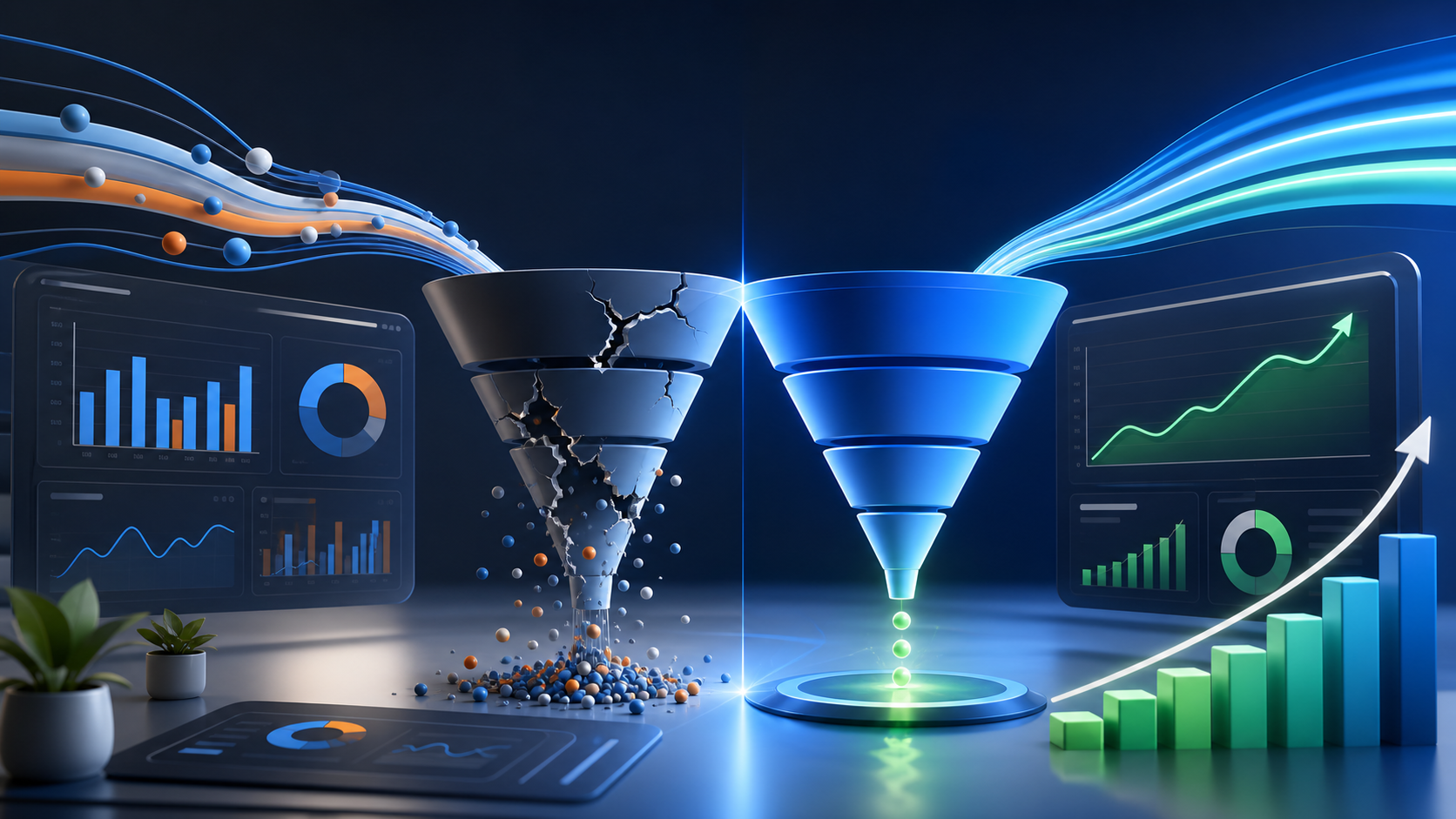
This is the Traffic Trap: scaling acquisition before fixing the conversion engine. When the website, offer, form, checkout, or follow-up process is leaking revenue, more traffic simply amplifies the loss.
If the funnel is weak, every new campaign sends more people into the same broken experience.
Small points of effort, confusion, or hesitation quietly destroy conversion performance.
Conversion Rate Optimization improves the value of traffic you already have before you buy more.
The Friction Epidemic: Why Visitors Leave
Many businesses assume their growth problem is a traffic problem. So the first reaction is usually to buy more ads, publish more content, or chase more keywords.
The deeper issue is often friction. A visitor lands on the page, but the offer is unclear, the next step is confusing, the form asks for too much, the mobile experience feels heavy, or the proof is not strong enough to create trust.
If a website converts at 2% and that rate improves to 3%, revenue from the same traffic can grow by 50% without increasing ad spend. That is why conversion should be treated as a growth lever, not a cosmetic website task.
The Biggest Revenue Leaks in Most Funnels
Before you optimize, you need to understand what is pushing people away. Most funnel leaks come from a few repeat offenders that look small on the surface but become expensive at scale.
- The paradox of choice: Too many offers, buttons, packages, or next steps can make visitors choose nothing. A strong page gives people one clear reason to act.
- High-friction forms and checkouts: Every unnecessary field, page, or approval step increases abandonment. If users have to work hard to convert, many of them will leave.
- The trust deficit: Testimonials, case studies, reviews, proof points, guarantees, and clear contact details reduce risk. Without trust, visitors hesitate.
- The mobile disconnect: A funnel that looks fine on desktop can fail badly on mobile. Slow pages, crowded layouts, and awkward forms destroy high-intent traffic.
Diagnosing the Leaks in Your Funnel
Escaping the Traffic Trap starts with diagnosis. Instead of guessing why people are not buying, look at each stage of the funnel and identify where intent is breaking down.
Top of funnel: Leaks often come from intent mismatch. The campaign promises one thing, but the landing page answers a different question. Review bounce rate, time on page, and campaign-by-campaign engagement.
Middle of funnel: Prospects are evaluating you here. They need clarity, comparison support, proof, and low-friction next steps. Session recordings, form analytics, and scroll depth can show where attention drops.
Bottom of funnel: These are the most painful leaks because the prospect is close to action. Unexpected costs, unclear pricing, confusing payment steps, or slow sales response can turn ready buyers into lost opportunities.
The Psychology Behind the Click
Conversion optimization is not only about button placement or page layout. It is about understanding how people make decisions when they are busy, uncertain, distracted, and comparing alternatives.
Reduce cognitive load. The brain avoids unnecessary effort. Clear headings, simple navigation, focused CTAs, and clean page hierarchy help visitors understand what to do next.
Use social validation. Reviews, customer counts, recognizable clients, before-and-after outcomes, and case studies reduce perceived risk because people trust evidence from others.
Create authentic urgency. Deadlines, limited availability, seasonal offers, and time-sensitive bonuses can help people act sooner, but only when they are real. False urgency damages trust.
A Practical CRO Framework for Better ROI
Weak CRO is random testing. Strong CRO is a structured process that connects data, customer behavior, and business goals.
- Data deep dive: Check technical performance, analytics, heatmaps, session recordings, and customer feedback to understand what is really happening.
- Hypothesis building: Turn observations into testable ideas. For example: we believe reducing form fields for mobile visitors will increase qualified enquiries because the current form causes abandonment.
- Prioritization: Rank fixes by impact and effort. High-impact, low-effort changes should move first because they build momentum quickly.
- Testing and measurement: Use A/B testing when traffic is high enough. For lower-traffic sites, implement carefully and compare against clean historical baselines.
A 60-Day Plan to Improve Conversion Performance
You do not need to rebuild everything at once. A focused 60-day plan can reveal the biggest leaks and create measurable improvement.
- Days 1-15: Configure analytics, install behavior tracking, audit your funnel on mobile, and ask recent customers what almost stopped them from buying.
- Days 16-30: Review your top pages, map drop-offs, study abandoned forms or carts, and write three to five specific hypotheses.
- Days 31-45: Sharpen the core offer, rewrite key headlines, remove non-essential form fields, simplify CTAs, and place stronger proof near decision points.
- Days 46-60: Launch tests where possible, monitor conversion rates, compare lead quality, and use the findings to plan the next optimization cycle.
Conclusion: Fix the Engine Before You Pour More Fuel
Traffic is only the beginning of growth. If your website is not built to turn that traffic into enquiries, calls, bookings, or sales, you are simply subsidizing platforms while your revenue stays stuck.
By shifting attention toward Conversion Rate Optimization, understanding buyer psychology, and systematically reducing friction, you can unlock stronger ROI from the traffic you already have before spending more to get new visitors.
If you are joining the upcoming webinar, Why More Traffic Will Not Fix Your Growth Problem, this is the mindset to bring: growth does not come from more attention alone. It comes from making that attention convert.
Frequently Asked Questions
Why does more traffic sometimes reduce ROI?
More traffic increases cost. If the website or funnel does not convert well, the business spends more without gaining enough additional revenue.
What is the fastest way to improve conversion rate?
Start by reducing obvious friction: clarify the offer, simplify forms, improve mobile usability, and add trust signals near important calls-to-action.
Should I stop running ads while improving CRO?
Not always. Keep profitable campaigns running, but avoid aggressively scaling spend until the landing page, tracking, and follow-up process are conversion-ready.
How long does CRO take to show results?
Some fixes can show improvement within days or weeks, while deeper testing cycles usually need 30 to 90 days depending on traffic volume and funnel complexity.
Want to Find the Leaks in Your Marketing Funnel?
Raja Digital Media helps businesses improve landing pages, lead flow, follow-up, and conversion performance before scaling ad spend.
Request a Funnel Review